
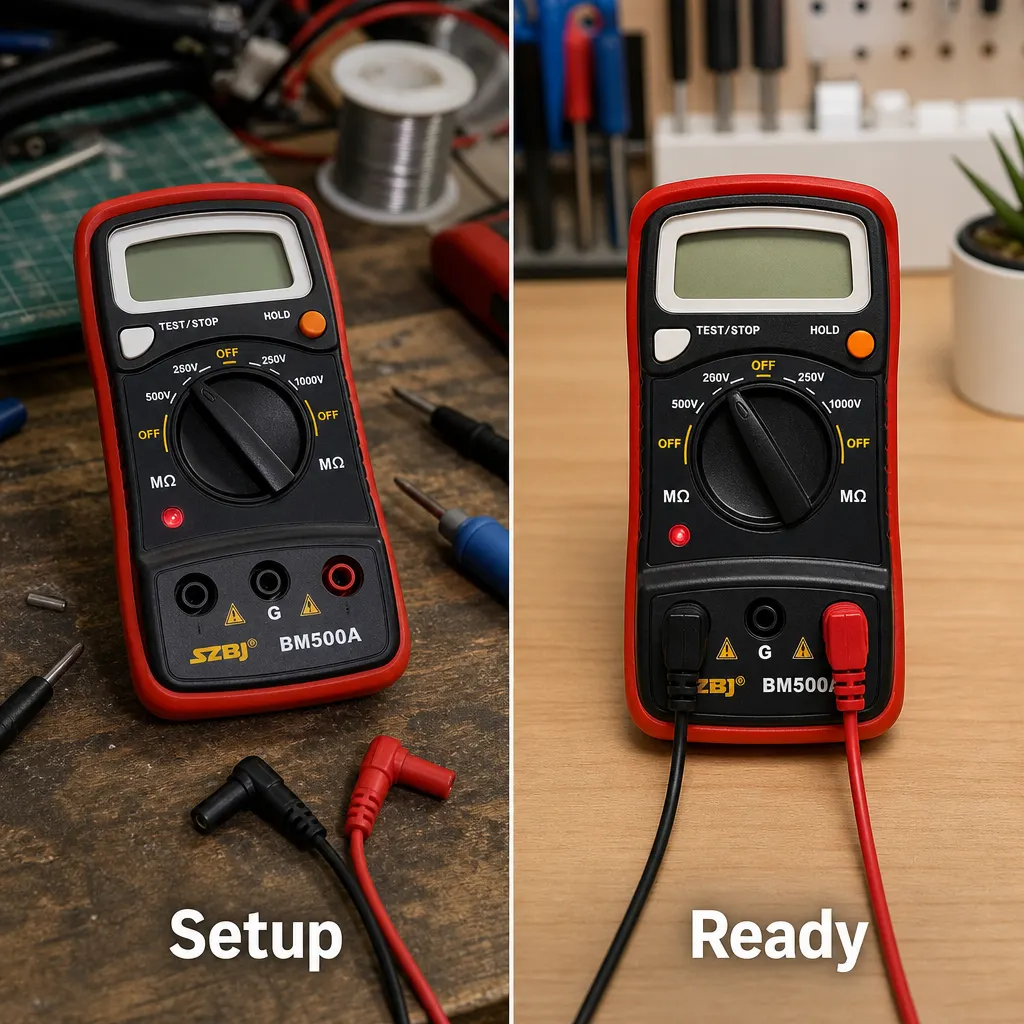
Short answer: A megohmmeter for UK electrical work should be selected against a documented procedure, not simply by maximum test voltage or price. The BM500A listing identifies a digital insulation resistance tester for cables, motors and installed electrical equipment. It shows marked 250 V, 500 V and 1000 V test ranges on an English-language battery pack and describes a compact format for service bags and site checks. The page does not publish CAT rating, accuracy, lead category, discharge behaviour or calibration. HSE guidance remains the safety reference for controlling electrical testing risk.
Megohmmeter or general multimeter?
The product page positions the BM500A as a dedicated insulation resistance tester rather than a general-purpose meter. It names cables, motors and installed electrical equipment and describes a compact, battery-powered format for service bags, workshops and on-site checks.
That category description is useful, but it does not identify every compatible asset. Manufacturer does not specify whether the instrument is suitable for a particular drive, control board, vehicle system, high-voltage assembly or connected electronic load.
| Evidence on the page | Boundary for the buyer |
|---|---|
| Digital insulation resistance tester | Do not assume all resistance or voltage functions of another meter |
| Cables, motors and installed equipment named | Do not extend the claim to an unlisted asset |
| 250 V, 500 V and 1000 V marked ranges | Do not choose a setting without the asset procedure |
A controlled test starts before connection
HSE guidance on electrical testing focuses on controlling danger arising from testing. HSE also says equipment and installations should be prepared by isolating and releasing relevant energy sources, with isolation secured against reintroduction. Those are conditions of the work, not optional features of a product listing.
The BM500A page does not provide an asset-specific isolation or discharge procedure. Use the responsible person's instructions and the equipment manufacturer's documentation, and stop when the required evidence is missing.
- Identify the equipment and the purpose of the insulation test.
- Confirm the approved test voltage and isolation method from the relevant procedure.
- Secure the isolation, prove the state and inspect the tester and leads.
- Document the result and complete the authorised discharge and return-to-service steps.
What a UK buyer should ask for
If the purchase enters a maintenance or inspection system, ask for the current manual and the evidence required by that system. Useful questions include the CAT rating, accuracy, lead category, overload protection, discharge behaviour, calibration process, environmental limits and service-life support.
The current listing does not answer those questions. Manufacturer does not specify them there, so do not describe the BM500A as CAT-rated, calibrated, certified or compliant with a named standard without separate documentation.
- Keep the model name and English-language battery configuration tied to the quotation.
- Match the three marked voltage options to the approved procedure, not to the instrument's maximum.
- Check the accessories and leads as separate evidence.
- Do not treat portability as proof of suitability for live or exposed-conductor work.
A restrained buying conclusion
The BM500A can be shortlisted when the buyer needs the product category and the named asset context matches. It should not be presented as a universal megohmmeter, a compliance certificate or a substitute for competent electrical work.
If the missing CAT, accuracy, discharge or calibration details are decisive, pause the order. Manufacturer does not specify those details on the product page, and guessing would turn a narrow product listing into an unsafe promise.
Related guides and product details
Buy only after the BM500A's documented limits and your approved electrical procedure agree; keep every missing safety parameter explicitly unresolved. Read Digital Megohmmeter: What the BM500A Listing Does Not Prove for related guidance. Read Insulation Resistance Tester UK: A Safe Buying Checklist for related guidance. Review the documented specification on the BM500A digital insulation resistance tester product page before ordering.
Sources and safety context
- Supports the model, named equipment, marked ranges, battery power and compact format. BM500A product page.
- Supports controlling danger during electrical testing. Safety in electrical testing at work.
- Supports secure isolation and energy release before work. Work on electrical equipment, machinery or installations.