
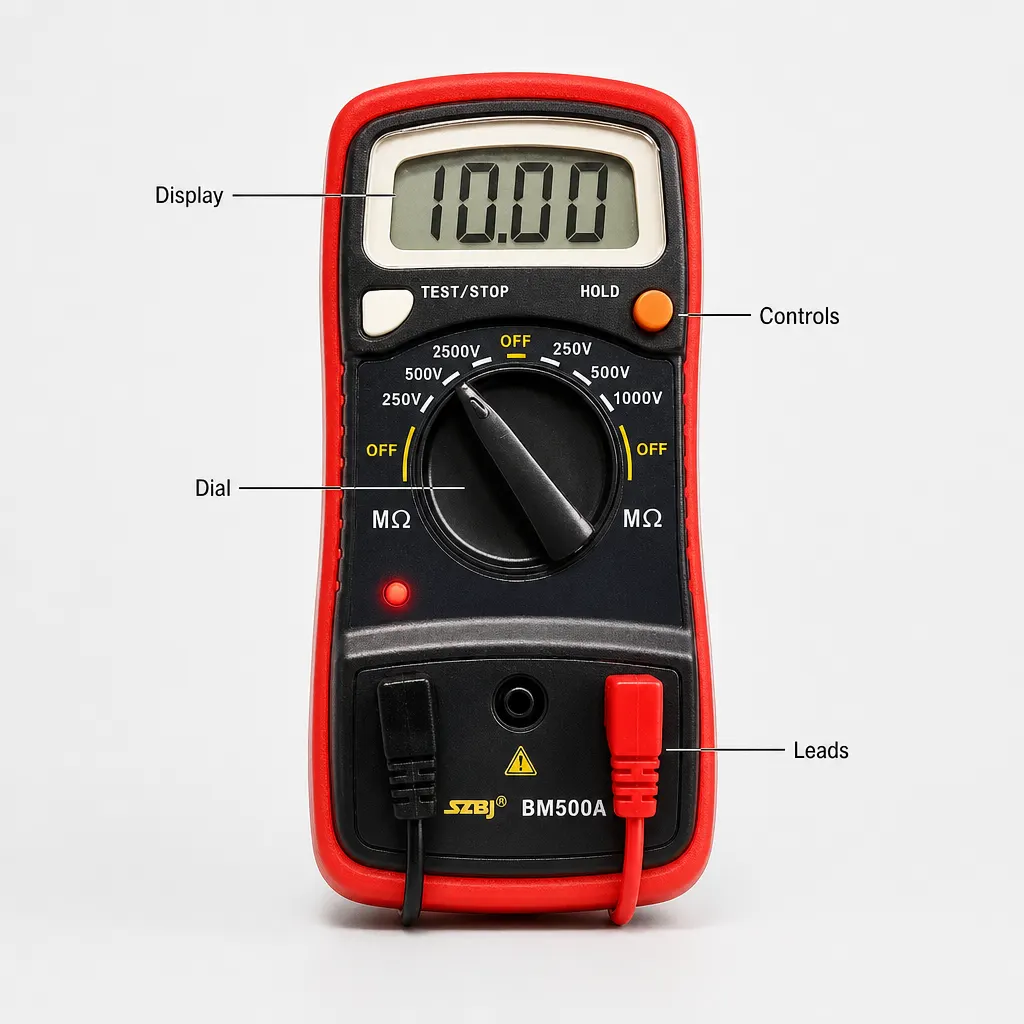
Short answer: When buying an insulation resistance tester in the UK, compare the instrument with the approved test procedure, the asset and the safety controls before comparing prices. The BM500A product page describes a handheld tester for cables, motors and installed electrical equipment, with marked 250 V, 500 V and 1000 V ranges on a battery-powered English-language pack. The page does not state CAT rating, accuracy, lead category, discharge behaviour or calibration. HSE guidance requires risks from electrical testing to be controlled, so this is a selection checklist, not a substitute for competence or site instructions.
Start with the work, not the product name
An insulation resistance tester is bought for a defined test context. The BM500A listing names cables, motors and installed electrical equipment and presents the unit as a compact, battery-powered instrument for workshops and on-site checks. Confirm that your work order uses this same instrument category.
Do not assume that a general search result proves suitability for every installation. The product page does not identify a CAT rating, accuracy class, permitted connected electronics, fuse system or inspection standard. Manufacturer does not specify those points.
| Buying question | Evidence currently available |
|---|---|
| Is it the right category? | The page calls it a digital insulation resistance tester |
| Which marked options are shown? | 250 V, 500 V and 1000 V |
| What safety class and accuracy apply? | Manufacturer does not specify |
| What accessories are included? | The product page does not provide a complete verified accessory specification |
Use HSE guidance as the boundary
HSE's electrical testing guidance is about controlling risk during testing, while its equipment guidance says energy sources should be isolated and released before work. Those principles apply before a buyer starts thinking about the selector position.
The product page cannot tell you how to isolate a particular machine, whether a connected control system can tolerate an insulation test or who is competent to make the acceptance decision. Follow the responsible person's procedure and the equipment manufacturer's instructions.
- Read the work instruction and identify the exact asset and circuit under test.
- Confirm isolation, secure the isolation and prove the required state with suitable equipment.
- Verify the tester and leads against the procedure before connecting them.
- Record readings and follow the site's discharge and return-to-service process.
Compare the missing evidence
The published 250 V, 500 V and 1000 V marks may be relevant to a procedure, but they do not tell the buyer which setting is correct. Selection depends on the asset, its documentation and the test method. Choosing the largest number because it is available is not a safe shortcut.
For a professional purchase, ask for the model manual, calibration route, accuracy, lead category, CAT rating, overload protection and discharge behaviour if the procedure requires them. Manufacturer does not specify these on the current product page, so the article does not invent them.
- Check the exact model, language pack and battery configuration.
- Check the stated accessory set against the site procedure.
- Check whether records, calibration and traceability are mandatory.
- Reject any assumption that the tester is safe for live work merely because it is portable.
When to stop the purchase
Pause when the employer's method statement requires evidence the listing does not provide. That includes a specified CAT rating, a known accuracy band, a named lead standard, automatic discharge or an environmental rating. A different documented tester may be the correct option.
This product page supports a narrow conclusion: BM500A is presented as a compact insulation-resistance tester with marked 250 V, 500 V and 1000 V ranges. It does not prove regulatory compliance, test performance or suitability for a particular vehicle, machine or installation.
Related guides and product details
Use the BM500A listing to shortlist a category, then require the procedure-specific manual and safety evidence before a UK work purchase. Read Megohmmeter UK: BM500A Fit and Safety Limits for related guidance. Read Digital Megohmmeter: What the BM500A Listing Does Not Prove for related guidance. Review the documented specification on the BM500A digital insulation resistance tester product page before ordering.
Sources and safety context
- Supports the named use, voltage marks, battery configuration and compact format. BM500A product page.
- Supports risk control during electrical testing. Safety in electrical testing at work.
- Supports secure isolation and release of energy before work. Work on electrical equipment, machinery or installations.