
Short answer: A digital megohmmeter is a specialist insulation-resistance tester, so the buying decision starts with the asset and procedure rather than the word digital. The BM500A listing describes a handheld tester for cables, motors and installed electrical equipment, with marked 250 V, 500 V and 1000 V test ranges on the English-language battery pack. It does not publish a CAT rating, accuracy, discharge behaviour, lead specification, overload protection or a complete test method. HSE guidance requires electrical testing risks to be controlled, so treat the listing as a product boundary, not permission to improvise live work.
What the BM500A page actually says
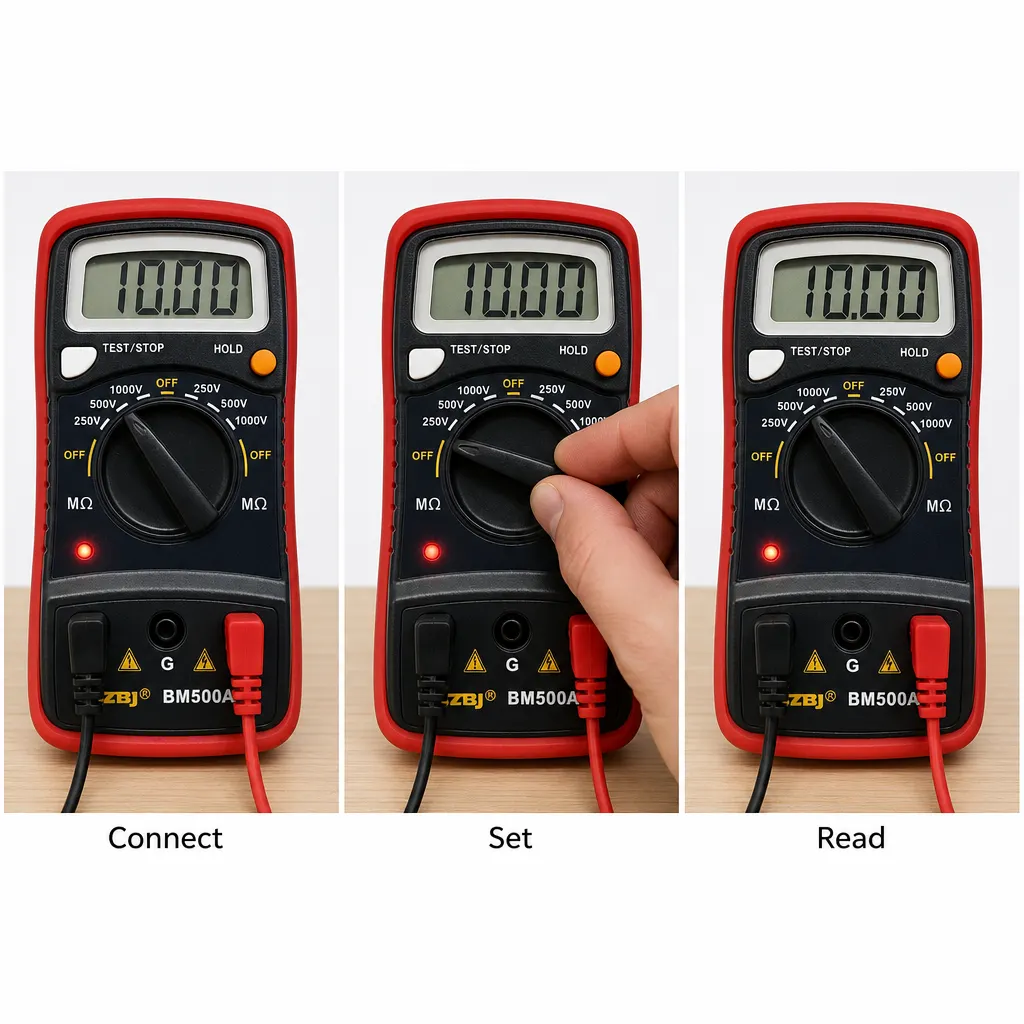
The product page describes the BM500A as a handheld digital insulation resistance tester for cables, motors and installed electrical equipment. It identifies marked 250 V, 500 V and 1000 V test ranges on the English-language pack and says the unit is battery powered and compact for service bags, workshops and on-site checks.
Those are product-page facts, not a certificate of performance. Manufacturer does not specify accuracy, resolution, CAT rating, maximum fault current, lead category, overload protection, automatic discharge, environmental rating, calibration interval or service life.
| Published fact | Do not infer |
|---|---|
| Marked 250 V, 500 V and 1000 V ranges | That every asset should be tested at any of those voltages |
| Handheld tester for insulation resistance | A CAT rating, accuracy class or compliance certificate |
| Battery-powered compact format | Safe operation on an energised circuit or a guaranteed battery runtime |
Set the safety boundary before testing
HSE guidance on electrical testing says the risks from testing must be controlled, and HSE guidance on work with electrical equipment stresses isolation and release of energy before work. Use the responsible person's procedure for the installation, asset and test point. Do not treat a battery-powered instrument as evidence that live or exposed-conductor work is acceptable.
This guide does not provide a live-circuit procedure. The correct test voltage, isolation method, discharge requirement and acceptance decision depend on the equipment, manufacturer instructions and the competent person's procedure. Manufacturer does not specify those details on the product page.
- Identify the asset, circuit and approved test procedure before selecting a voltage range.
- Isolate and secure all relevant energy sources, then prove the required state with suitable equipment.
- Check the tester, leads, terminals and batteries for damage and confirm the documented limits.
- Record the result and follow the responsible procedure for discharge, re-energisation and escalation.
Buying checks for electricians and maintenance teams
The listing is relevant when the buyer needs a dedicated insulation-resistance tester for the types of assets named on the page. It is not enough when the work specification requires a verified CAT rating, a stated accuracy, a particular lead set, automatic discharge, timed testing, data logging or a calibration certificate.
Ask for the missing evidence before ordering if the instrument will enter an employer's inspection system. Do not copy a CAT level, accuracy figure or test voltage from another BM-series instrument. Manufacturer does not specify them for this listing unless the current documentation says otherwise.
- Confirm the exact BM500A identity and English-language battery configuration.
- Match the instrument to the employer's test procedure and the asset manufacturer's instructions.
- Require documented accessories and calibration evidence when the procedure depends on them.
Limits and unknowns before purchase
A megohmmeter can produce a test condition that is unsuitable for a connected electronic system or an inadequately isolated circuit. The safe choice is governed by the approved procedure, not by the highest number printed on a selector. HSE guidance supports controlling the testing risk; it does not endorse this product or supply a model-specific procedure.
The product page does not state measurement accuracy, CAT rating, output behaviour, discharge time, fuse arrangement, lead category, ingress protection or service life. If any of those facts are mandatory, manufacturer does not specify them and the purchase should pause.
Related guides and product details
Choose the BM500A only when its documented role fits an approved, controlled procedure and the missing electrical safety evidence has been resolved. Read Insulation Resistance Tester UK: A Safe Buying Checklist for related guidance. Read Megohmmeter UK: BM500A Fit and Safety Limits for related guidance. Review the documented specification on the BM500A digital insulation resistance tester product page before ordering.
Sources and safety context
- Supports the model, named use, marked voltage ranges, battery power and compact format. BM500A product page.
- Supports the need to control risks during electrical testing. Safety in electrical testing at work.
- Supports isolation and release of energy before work. Work on electrical equipment, machinery or installations.